timecorr: A Python toolbox for calculating dynamic correlations and exploring higher order correlations#
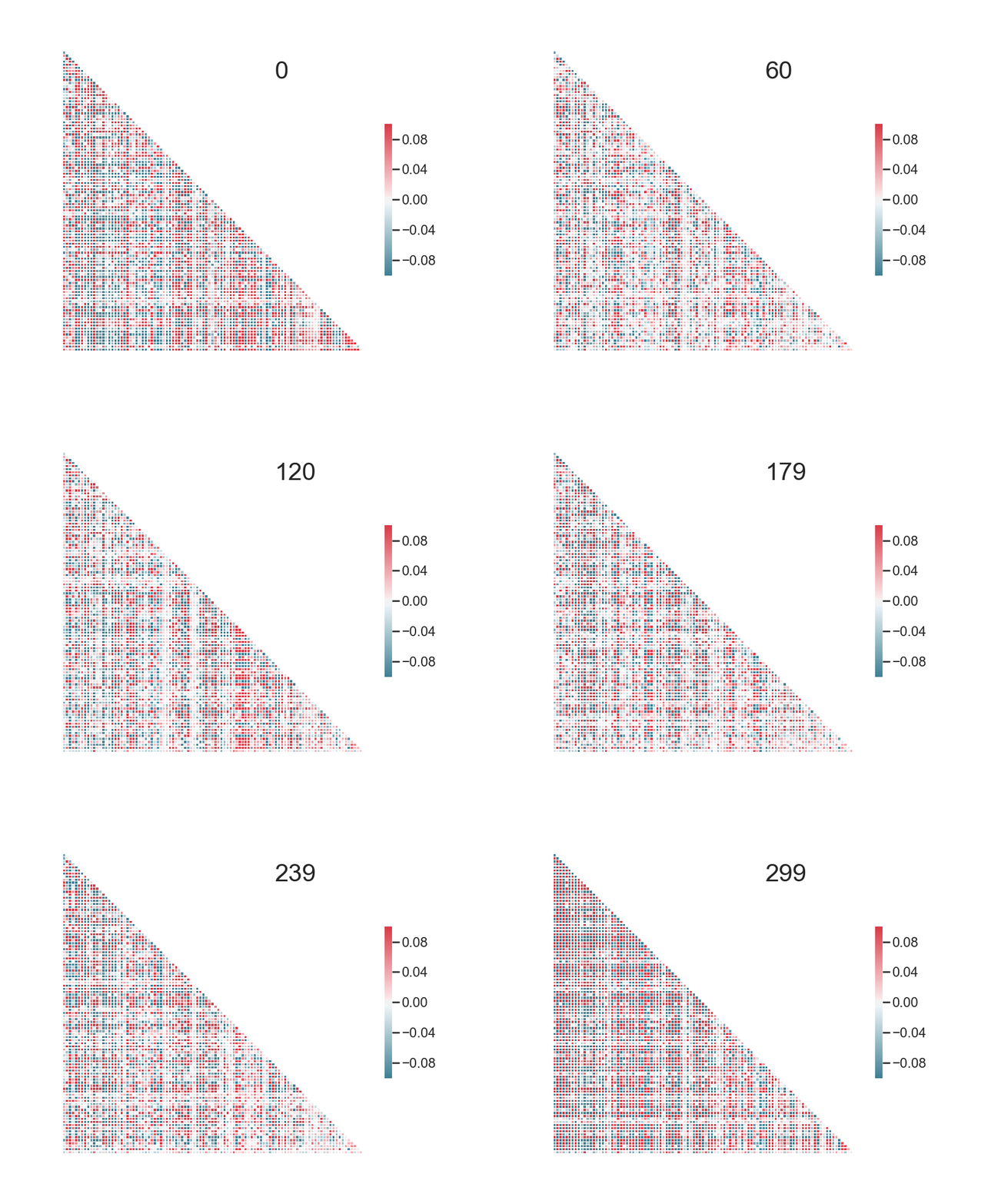
Welcome to TimeCorr#
The TimeCorr toolbox provides tools for computing and exploring the correlational structure of timeseries data. This powerful package allows you to analyze how correlations between variables change over time, making it ideal for studying dynamic brain networks, market correlations, climate patterns, and other time-varying systems.
Key Features#
Dynamic Correlations: Compute moment-by-moment correlations between features
Higher-Order Analysis: Explore correlations between correlations (and beyond)
Multi-Subject Analysis: Compare patterns across different datasets/participants
Flexible Kernels: Gaussian, Laplace, Mexican Hat, and custom weighting functions
Dimensionality Reduction: PCA, ICA, factor analysis, and graph-theoretic measures
Statistical Testing: Built-in permutation testing and multiple comparisons correction
Quick Start Example#
import numpy as np
import timecorr as tc

# Generate sample data: 100 timepoints, 5 features
data = np.random.randn(100, 5)

# Compute dynamic correlations with Gaussian weighting
correlations = tc.timecorr(data,
                          weights_function=tc.gaussian_weights,
                          weights_params={'var': 10})

print(f"Input shape: {data.shape}")
print(f"Output shape: {correlations.shape}")  # (100, 15) - vectorized correlation matrices
Multi-Subject Analysis#
# Analyze correlations across multiple subjects
subjects_data = [np.random.randn(100, 5) for _ in range(10)]  # 10 subjects

# Inter-Subject Functional Connectivity (ISFC)
isfc_results = tc.timecorr(subjects_data,
                          cfun=tc.isfc,
                          weights_function=tc.gaussian_weights)

# Weighted ISFC for similarity-based averaging
wisfc_results = tc.timecorr(subjects_data,
                           cfun=tc.wisfc,
                           weights_function=tc.gaussian_weights)
Installation#
Install the latest stable version using pip:
pip install timecorr
Or for the latest development version:
pip install --upgrade git+https://github.com/ContextLab/timecorr.git
Contents#
User Guide
API Reference